
In the heart of Concarneau’s walled town
Finistère’s famous fortified town
The emblematic silhouette of Finistère, Concarneau is an important part of Brittany ‘s history. The “Ville Bleue” d’Art et d’Histoire (Blue City of Art and History) conceals many treasures: its Kériolet castle, its fishing and yachting harbour, its sandy beaches, but above all its famous Ville Close (Walled City). Discover this emblematic town during your stay on a camping in Concarneau.
Brittany’s second most visited monument
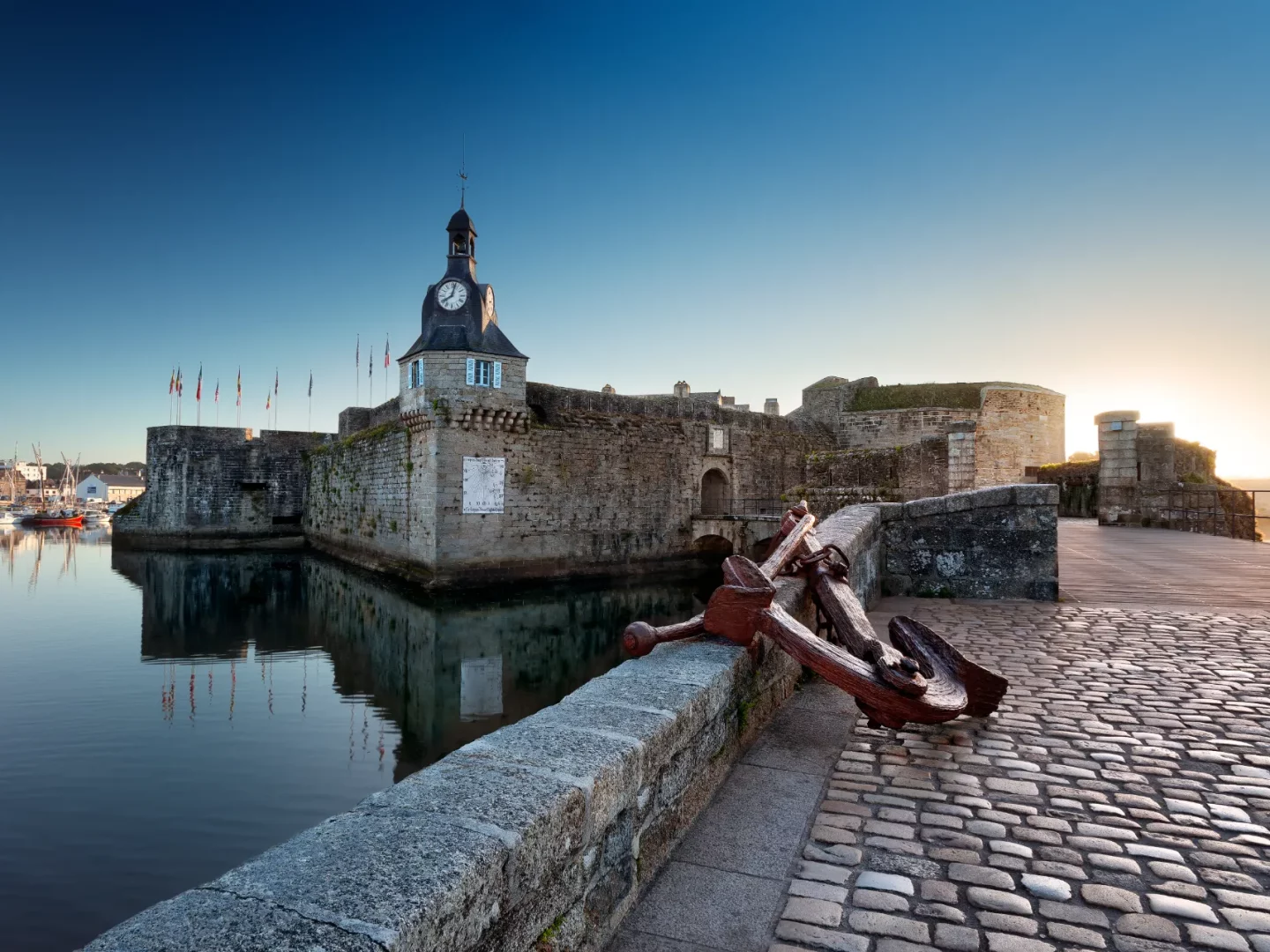
In South Finistère, some fifteen kilometers from Camping La Roche Percée, the Ville Close is the historic center of Concarneau. Built on a small island 350 m long and 100 m wide, in the Baie de la Forêt, the town was fortified in the 15th century and became Brittany ‘s fourth stronghold. Today, walkers and tourists alike have made it Brittany ‘s second most visited site. Over one and a half million tourists flock here every year. A word of advice: it’s best to go in the morning to avoid the crowds.
A stroll through the Ville Close, a well-guarded jewel of Finistère
Behind its thick ramparts, the city of Concarneau can be explored on foot, with the wind in your face. The belfry clock marks the entrance to the Ville Close, the fortified town. Crossing the old drawbridge on the faubourg side, visitors are greeted by two impressive cannons, a reminder of the town’s military past.
The intramuros and its maze of narrow streets offer a lovely historical stroll that takes you all the way to the Porte aux Vins, one of the most beautiful gates in the Ville Close, opening onto the ramparts. Rue Vauban, the citadel’s main street, is lined with solid granite houses whose first floors are now home to souvenir shops, Breton specialties, bars, ice cream parlors and typical restaurants. All summer long, the Ville Close offers a host of entertainment: street shows, dance, music, theater… And don’t forget the Festival des Filets Bleus, Concarneau ‘s flagship summer event, held along the quays at the foot of the Ville Close.
When it comes to heritage, the Ville Close is very generous, with several listed historic monuments: timber-framed houses in schist and granite, sculpted lintels, vaulted passageways, gates and posterns pierced in the ramparts, and more. At the entrance to the town, the Governor’s House is one of two timber-framed houses still visible in Concarneau, dating from the 17th century. Today, it houses the Maison du Patrimoine. The Hervo barracks on rue Vauban, now home to the Musée de la Pêche de Concarneau, are also well worth a visit. The oldest building in this complex is the Notre-Dame-du-Portail chapel , first mentioned in 1539.
Another place to linger is Place Saint Guénolé, where you’ll find a stunning crocodile fountain. It is decorated with a curious aquatic bestiary: a turtle and an otter flank a crocodile holding a fish with a lantern in its mouth. Just a stone’s throw away, at the entrance to the Petit Château, take a look at the former powder magazine of the Ville Close, with its level floor and surrounding wall, for which it has been classified as a historic monument.
The ramparts promenade
The Ville Close owes its name to the ramparts that surround it. These high walls were built between 1541 and 1577, and then modified by Vauban in the 17th century. Today’s 980-meter wall is flanked by eight listed towers linked by machicolated curtain walls.
For a tour of Concarneau ‘s ramparts, head for the foot of the Governor’s Tower, at the entrance to the Ville Close. The walk along the ramparts offers beautiful views over the town, the port and Concarneau Bay. Explanatory panels along the way make it easy to understand the site.